Friday, 20 May 2022

MECHANISM OF CELLULAR DRUG ABSORPTION

MECHANISM OF DRUG ABSORPTION

Link for video demonstration of this topic 👇
 https://youtu.be/v-nVH7y1Cc8

The three broad categories of drug transport mechanisms involved in absorption are – 
A. Transcellular/intracellular transport
B. Paracellular/intercellular transport 
C. Vesicular transport

TRANSCELLULAR/INTRACELLULAR TRANSPORT
It is defined as the passage of drugs across the GI epithelium. It is the most common pathway for drug transport. The 3 steps involved in transcellular transport of drugs are – 
(i) Permeation of GI epithelial cell membrane, a lipoidal barrier –this is the major obstacle to drug absorption. 
(ii) Movement across the intracellular space (cytosol). 
(iii) Permeation of the lateral or basolateral membrane- this is of secondary importance. 
The various transcellular transport processes involved in drug absorption are –
1. Passive Transport Processes – These transport processes do not require energy other than that of molecular motion (Brownian motion) to pass through the lipid bilayer. Passive transport processes can be further classified into following types – 
a. Passive diffusion. 
b. Pore transport. 
c. Ion-pair transport. 
d. Facilitated- or mediated-diffusion.
a. Passive transport
b. Pore transport
c. Ion-pair transport
d. Carrier mediated transport

2. Active Transport Processes – This transport process requires energy from ATP to move drug molecules from extracellular to intracellular area. These are of two types –
a. Primary active transport(use of ATP). 
b. Secondary active transport(use of any other form of energy) – this process is further subdivided into two –
i. Symport (co-transport). 
ii. Antiport (counter-transport).
PARACELLULAR/INTERCELLULAR TRANSPORT
It is defined as the transport of drugs through the junctions between the GI epithelial cells. This pathway is of minor importance in drug absorption. The two paracellular transport mechanisms involved in drug absorption are – 
1. Permeation through tight junctions of epithelial cells – this process basically occurs through openings which are little bigger than the aqueous pores. Compounds such as insulin and cardiac glycosides are taken up this mechanism. 
2. Persorption – is permeation of drug through temporary openings formed by shedding of two neighbouring epithelial cells into the lumen.

VESICULAR/CORPUSCULAR TRANSPORT
Like active transport, these are also energy dependent processes but involve transport of substances within vesicles into a cell. Since the mechanism involves transport across the cell membrane, the process can also be classified as transcellular. Vesicular transport of drugs can be classed into two categories –
1. Pinocytosis. 
2. Phagocytosis.
Illustrative comparison of transcellular, paracellular and vesicular transport.
Figure 1: comparison of transcellular, paracellular and vesicular transport mechanisms. 

Saturday, 9 April 2022

DENTAL & COSMETIC PREPARATIONS: Anti-perspirant & Deodorant

ANTI-PERSPIRANT & DEODORANT

Link for notes on this topic 👇👇👇
https://youtu.be/Yjj9_EiLrC0
A deodorant is a substance applied to the body to prevent body odour caused by the bacterial breakdown of perspiration in armpits, feet, and other areas of the body. A subgroup of deodorants, antiperspirants, affect odour as well as prevent sweating by affecting sweat glands.
Antiperspirants are typically applied to the under arms, while deodorants may also be used on feet and other areas in the form of body sprays. In the United States, the food and drug administration classifies and regulates most deodorants as cosmetics but classifies antiperspirants as over-the-counter drugs. 

TYPES OF ANTIPERSPIRANT-

1.Aerosol 
2.Sticks 
3.Cream

IDEAL PROPERTIES
• It should not be irritant to the skin. 
• It should not deteriorate clothing. 
• It should be safe and nontoxic. 
• Easy to use and adhere well on skin. 
• Mask body odour with perfume. 
• Absorb perspiration or inhibit the activity of gram+ ve bacteria , which cause body malodour.

FORMULATION

  • Aluminum salts (aluminum chlorohydrate, aluminum zirconium tetrachlorohydrex gly, and others) – used as the basis for almost all non-prescription (everyday) antiperspirants. The aluminium reacts within the sweat gland to form a colloid which physically prevents sweating.
  • Alum (typically potassium alum or ammonia alum, also described as "rock alum", or "rock crystal", or "natural deodorant"). Alum is a natural crystalline product widely used both historically and in modern times as a deodorant, because it inhibits bacterial action. The word 'alum' is a historical term for aluminum sulfate salts, therefore all alum products will contain aluminum.
  • Bactericidal products such as triclosan and parabens kill bacteria on the skin.
  • Alcohols and related compounds such as propylene glycol – these products can have both drying and bactericidal effects.
  • Methenamine (hexamethylenetetramine, also known as hexamine or urotropin) is a powerful antiperspirant, often used for severe sweat-related issues, as well as prevention of sweating within the sockets of prosthetic devices used by amputees. 
  • Acidifers and pH neutral products – deodorants that prevent bacterial action by enhancing (or at least, not depleting) the skin's natural slight acidity, known as the acid mantle, which naturally reduces bacterial action but can be compromised by typically alkaline soaps and skin products.
  • Masking scents – other strong or overriding scents of a pleasing type may be used, used to mask bodily odours. Typically these are strongly smelling plant extracts or synthetic aromas.
  • Activated charcoal and other products capable of adsorbing sweat and/or smell. Although charcoal most often has a black colour, the activated charcoal used in deodorants may be a very light colour for aesthetic reasons.
  • Less commonly used, products such as Milk of Magnesia (a thick liquid suspension of magnesium hydroxide) are sometimes used as deodorants.


Tuesday, 22 February 2022

ABSORPTION OF DRUGS (Biopharmaceutics and Pharmacokinetics)

ABSORPTION OF DRUGS

Link for video demonstration 👇
1. https://youtu.be/coxjQQHId7c
2. https://youtu.be/XPO164AFKtA

INTRODUCTION TO BASIC TERMINOLOGIES TO BIOPHARMACEUTICS & PHARMACOKINETICS

Biopharmaceutics is defined as the study of factors influencing the rate and amount of drug that reaches the systemic circulation and the use of this information to optimise the therapeutic efficacy of the drug products.
Bioavailability is defined as the rate and extent (amount) of drug absorption.

Absorption is the process of movement of drug from its site of administration to the systemic circulation.

Drug distribution is the movement of drug between one compartment and the other (generally blood and the extravascular tissues).

Elimination is defined as the process that tends to remove the drug from the body and terminate its action.

Elimination occurs by two processes—biotransformation (metabolism), which usually inactivates the drug, and excretio which is responsible for the exit of drug/metabolites from the body.

Pharmacokinetics is defined as the study of time course of drug ADME and their relationship with its therapeutic and toxic effects of the drug. 
Pharmacokinetics is a study of what the body does to the drug, that relates changes in concentration of drug within the body with time after its administration.

Pharmacodynamics is a study of what the drug does to the body, that relates response to concentration of drug in the body.

INTRODUCTION TO ABSORPTION OF DRUGS

Drug absorption is defined as the process of movement of unchanged drug from the site of administration to systemic circulation.
This definition takes into account the loss of drug that occurs after oral administration due to presystemic metabolism or first-pass effect. 
Not only the magnitude of drug that comes into the systemic circulation but also the rate at which it is absorbed is important. A drug that is completely but slowly absorbed may fail to show therapeutic response as the plasma concentration for desired effectis never achieved. On the contrary, a rapidly absorbed drug attains the therapeutic level easily to elicit pharmacological effect. Thus, both the rate and the extent of drug absorption are important.

ABSORPTION OF DRUG FROM COMMON ROUTES OF DRUG ADMINISTRATION (PARENTAL)


Intravenous: Complete (100%) systemic drug absorption 
Advantages-
Drug is given for immediate or controlled effect, may inject large fluid volumes, suitable for irritating drugs.
Disadvantages-
Increased chance for adverse reaction, requires skill in insertion of infusion set, tissue damage at site of injection.

Intramuscular injection: Rapid absorption from aqueous solutions & Slow absorption from non-aqueous (oily) solutions. 
Advantages-
Easier to inject than intravenous injection, larger volumes may be used compared to subcutaneous solution.
Disadvantges-
Irritating drugs may be very painful,variable rates  absorption, depending upon muscle group injected and blood flow.

ABSORPTION OF DRUG FROM COMMON ROUTES OF DRUG ADMINISTRATION (ENTERNAL)

Buccal or sublingual (SL): Rapid absorption of lipid-soluble drugs.
Advantages-
No presystemic metabolism.
Disadvantages-
Some drug may be swallowed. Not for most drugs or drugs with high doses.

Oral (PO): Absorption may vary. Generally slower absorption rate compared to IV bolus or IM injection.
Advantages-
Safest and easiest route of drug administration. 
Suitable for both immediate-release and modified-release drug products.
Disadvatages-
Some drugs are unstable in GIT, or undergo presystemic metabolism or show erratic absorption.

Rectal (PR): Absorption may vary from suppository. More reliable absorption from enema (solution). 
Advantages-
Useful when patient cannot swallow medication.
Used for local and systemic effects.
Disadvantages-
Absorption may be erratic. 
Suppository may migrate to different position.
Some patient discomfort.

ABSORPTION OF DRUG FROM VARIOUS OTHER ROUTES OF DRUG ADMINISTRATION 

Transdermal: Slow absorption, rate may vary.
Advantages-
Increased absorption with occlusive dressings.
Transdermal delivery system (patch) is easy to use and withdraw.
Continuous release for a specified period.
Disadvantages-
Used for lipid-soluble drugs with low dose and low MW.
Low presystemic metabolism.
Some irritation by patch or drug. 
Permeability of skin variable with condition, anatomic site, age, and gender.
Type of cream or ointment base affects drug release and absorption.

Inhalation: Rapid absorptio, total dose absorbed is variable.
Advantages-
May be used for local or systemic effects.
Disadvantages-
Particle size of drug determines anatomic placement in respiratory tract.
May stimulate cough reflex. 
Some drug may be swallowed.

CELLULAR MEMBRANE: STRUCTURE & PHYSIOLOGY

For a drug to be absorbed and distributed into organs and tissues and eliminated from the body, it must pass through one or more biological membranes/barriers at various locations. Such a movement of drug across the membrane is called as drug transport. 
The basic structure of cell membrane is shown as:
The cellular membrane consists of a double layer of amphiphilic phospholipid molecules arranged in such a fashion that their hydrocarbon chains are oriented inwards to form the hydrophobic or lipophilic phase and their polar heads oriented to form the outer and inner hydrophilic boundaries of the cellular membrane that face the surrounding aqueous environment. Globular protein molecules are associated on either side of these hydrophilic boundaries and also interspersed within the membrane structure. In short, the membrane is a mayonnaise sandwich where a bimolecular layer of lipids is contained between two parallel monomolecular layers of proteins. The hydrophobic core of the membrane is responsible for the relative impermeability of polar molecules. Aqueous filled pores or perforations of 4 to 10 Ã… in diameter are also present in the membrane structure through which inorganic ions and small organic water-soluble molecules like urea can pass. In general, the biomembrane acts like a semipermeable barrier permitting rapid and limited passage of some compounds while restricting that of others. 
The GI lining constituting the absorption barrier allows most nutrients like glucose, amino acids, fatty acids, vitamins, etc. to pass rapidly through it into the systemic circulation but prevents the entry of certain toxins and medicaments. Thus, for a drug to get absorbed after oral administration, it must first pass through this barrier.


Monday, 8 November 2021

COSMETIC PREPARATION: Shampoo

INTRODUCTION

Link for video demonstration of this topic 👇
https://youtu.be/QHwms3VDRxc (Part 1)
https://youtu.be/v6Oug9RqMKA (Part 2)

Formulation-
https://youtu.be/Wp7NV46Y8Os (Part 1)
https://youtu.be/t5-aFS4AV78 (Part 2)

Preparation-
https://youtu.be/RYPuVHlA-hY

Evaluation-
https://youtu.be/TXwpWMMwRhI


A viscous cosmetic preparation with synthetic detergent used for washing hair is called shampoo. 
Its principle function is to clean the scalp such that it should become free from sebum and foreign substances.

IDEAL PROPERTIES

Ideal properties are:
• It should have optimum viscosity such that it facilitates ease during application. 
• It should have good spreading properties. 
• It should produce sufficient lather after application. 
• It should be able to remove waste material such as debris, soil, sebum, dead cells, salts (due to sweat) etc., from the scalp. 
• It should not form any kind of film on scalp. 
• It should rinse out completely after washing. 
• It should produce lather with both hot and cold water. 
• It should facilitate ease of combing after shampooing. 
• After drying, the hair should not give rough appearance. 
• It should provide lustre to the hair. 
• It should produce good odour both before and after shampooing. 
• It should not produce any kind of irritation or itching to the scalp. 
• It should not support any microbial growth. 
• It should be stable and have a half life of about 2 to 3 years. 
• It should be economical.

TYPES OF SHAMPOOS

1. Clear liquid shampoos 
2. Liquid cream shampoos 
3. Cream shampoos 
4. Gel shampoos 
5. Powder shampoos 
6. Aerosol shampoos (Foam type) 
7. Special shampoos

1. Clear Liquid Shampoos: These are clear liquid preparations that are most widely used. They are usually made by using detergent of low cloud point. 
2. Liquid Cream Shampoos: These are called as lotion shampoos which are modification of clear liquid shampoos. Addition of opacifier such as glycerylmonostearate, glycol stearate  etc., to the clear liquid shampoo yields liquid cream shampoo.
3. Cream Shampoos: These shampoos have a paste like consistency and are packed in a collapsible tube. The paste consistency is developed by addition of alkyl sulphates, also Cetyl alcohol is added, which serves as a builder.
4. Gel Shampoos: These are transparent and thick usually made by incorporating a gelling agent, (e.g., cellulose).These are great use in hair salons and beauty parlors. The main ingredient is detergent which can be used either alone or in combination with soap. Addition of methyl cellulose to clear liquid shampoo and its subsequent thickening also gives rise to gel shampoo. 
5. Powder Shampoos: It is available in the form of dry powder, initially it was prepared from dry soaps, but nowadays dry synthetic detergents are used for their preparation. Powder shampoo is prepared where addition of water or other solvent reduces the activity of the components, especially in case of medicated shampoo. Nowadays, these shampoos are not used due to the difficulty experienced in their application. 
6. Aerosol Shampoos: They are called aerosol shampoos because they are packed in aerosol containers .Their formulation, preparation and packing is complicated as an additional propellant is included. The propellant added must be compatible and should not reduce the activity of shampooing ingredients. The container opening is provided with a valve. Shampoo comes out as foam when the valve is pressed. Hence also called as foam type shampoo. 
7. Special Shampoos:
(a) Medicated shampoo: These shampoos contain medicinal agents. These agents treat the disorders of the scalp or hair. Examples of medicated shampoos are: Anti-lice shampoo, Anti-dandruff shampoo, Anti-baldness shampoo etc,. 
The medicinal agent added should not irritate the sebaceous glands. It should not sensitize the scalp. The degree of itching and scaling should also be reduced. Among all, anti-dandruff type of medicated shampoo is most widely used. 
(b) Conditioner Shampoos: These shampoos serve for hair conditioning. Initially they clean the hair (and scalp) and keep them in smooth and lustrous condition. 
Most of the conditioners are made from Quaternary ammonium compounds. These compounds have the property of reducing electric charges between the hair, as a result hair become lustrous easily manageable. These compounds can also exhibit a bactericidal effect. 

FORMULATION OF SHAMPOO

Surfactants: The main use of surfactant is to cleanse and to produce foam. They are generally categorized into four types. 
They are: 
(a) Anionic Surfactants 
(b) Non-ionic surfactants 
(c) Cationic Surfactants 
(d) Amphoteric Surfactants 
(a) Anionic Surfactants: These surfactants have good foaming property, hence they are used as principle surfactant. They are considered as main ingredient of shampoo formulation. 
Examples of Anionic Surfactants: Alkyl sulphates (Lauryl Sulphate), α- olefin Sulphate (sulphosuccinates) etc.
(b) Non-ionic Surfactant: These are considered as secondary surfactants. They are not used to produce foam but used as foam boosters, viscosity inducers, emulsion stabilizers and opacifiers. This is because they have less foaming power. Even though they have good cleaning property, they are not used as principle surfactant. Examples of Non-ionic surfactants: Poly-alkoxylated Derivatives, Fatty Acid alkanolamides (Lauric Monoethanolamide).
(c) Cationic Surfactants: Surfactants that contains positive charge are called as cationic surfactants. They are used as both principle and secondary surfactants. These surfactants are used in low concentrations because they are toxic to eye. Hence, they are considered as secondary surfactants. Apart from the above toxic effect, they also have good foaming and partly cleaning properties. Hence, they are also used as principle surfactants in conditioner shampoos. Examples of Cationic Surfactants: Alkylamines, Ethoxylated amines.
(d) Amphoteric Surfactants: The surfactants which possess both cationic and anionic charges with respect to acidic and basic media are called as amphoteric solvents. They form zwitterions when the pH of media is neutral.These agents produces a mild action and show compatibility with surfactants . They posses excellent hair conditioning property and hence used as secondary surfactants. Examples of Amphoteric Surfactants: Dialkyl Ethylene Diamines, N-alkyl Amino Acids.

Foam Boosters: They form rich lather i.e. foam which is stabilized or strengthened by using a substance called foam boosters. They make the foam dense and it to remain for long duration. Usually they are added in quantity of about 2 to 5%. 
Fatty acids and fatty alcohols when added in a range of 0.25 to 0.50% concentrations, they also act as foam boosters. 
Examples of foam boosters: Monoethanolamides, lauramides DEA etc.

Germicide and Anti-dandruff Agents: Germicides are the agents which prevent the growth of micro-organism on the scalp whereas anti-dandruff agents are used to eliminate dandruff from the scalp. 
Examples of Germicides are: 
• Quaternary ammonium compounds: Benzalkonium Chloride, Cetrimide etc. 
Examples of Anti-dandruff Agents are: 
• Selenium Sulphide 
• Cadmium Sulphide 

Conditioning Agents: These agents improve the condition of hair. These agents have the property of reducing, electric charges the hair, as a result, hair become lustrous and hence easily manageable. These agents also exhibit a bactericidal effect. They make the hair silky and shiny. 
Examples of conditioning agents: lanolin, oils, herbal extracts, egg, amino acids etc. of which amino acid gives good conditioning effect. 

Pearlescent agent: These agents are usually added as adjuvants to the conditioning agents. They improve the conditioning property. Addition of these agents also imparts brightness to hair. They make the preparation opaque; hence they are also called as opacifying agents. 
Example of pearlescent agents are alkanolamides and coumarins like 4-methyl-7-diethyl amino coumarin, 4-methyl-5, 7-dihydrocoumarin etc. 

Sequestrants: These are complex forming agents. They form complex with metal ions like calcium and magnesium. Surfactant are liable to form complex with the metals present in water i.e., calcium and magnesium. Hence addition of Sequestrants prevents complex formation between metal and surfactant. The Sequestrant itself forms complex with the metal ions. Thus, it prevents the formation of film on the scalp i.e., the film formed by surfactant and metal ions. The commonly used Sequestrants are EDTA, citric acid etc,. 

Thickening agent: These agents are usually added to make the preparation thick i.e. viscous. Such viscous preparation facilitates ease of handling. Also, they prevent wastage during application. Already the addition of various agents, such as surfactants, foam boosters etc make the preparation viscous even though thickening agent is added. 
Example of commonly used thickening agent are methyl cellulose, alginates polyvinyl alcohol, polyethylene glycol etc.

Perfumes: Addition of these agents imparts good fragrance to the shampoo. It also neutralizes the undesirable odour of other ingredients of formulation especially surfactants. Nowadays it has become an important factor for consumer satisfaction. The selected perfumes must be such that they should retain good smell for fixed period of time even after shampooing. The added perfumes should not affect the solubility and stability of the preparation. They are usually obtained from natural sources such as flowers, fruits, herbs etc. 

Preservatives: These agents have the ability to prevent the growth of micro-organisms. They are usually added to maintain the stability of the preparation for a desired period of time. Shampoo is a wet preparation that provides a media for various micro organisms hence addition of preservative is essential. Preservative used should not cause any irritation to the scalp. 
Example of commonly preservatives are para-hydroxybenzoic acid and phenyl mercuric nitrate.

Colouring agents: Addition of colour gives pleasant appearance to the preparation. Various FD & C dyes are used for colouring the preparation. The added colour must be water soluble and it should not impart any colour to hair or scalp. 

PREPARATION OF SHAMPOO


Liquid Shampoo Preparation

• Initially the detergent is converted into a solution form or a detergent solution directly obtained from the manufacturer. 
• Take about half of the detergent solution into a separate container. To it, add the total amount of secondary surfactant i.e., alkanolamide. 
• Dissolve the alkanolamide along with stirring. Sometimes, gentle heat is also applied. 
• To the remaining half of the detergent solution add suitable amount of perfuming agent and dissolve it. 
• The perfume solution is then added to the alkanolamide solution. 
• Colour and preservatives are dissolved separately in sufficient volume of water and then added to the main solution. 
• The whole, solution is mixed well by gentle stirring. Excessive stirring may lead to bubble formation. 
• Final volume of the preparation is usually adjusted by the addition of clear sterile water. This gives clear liquid shampoo.
• However, when the preparation contains lauryl alcohol ether sulphate. It is required to adjust the viscosity of the shampoo. 
• Viscosity adjustment is done by using an electrolyte solution. Usually, a solution of sodium chloride is added subsequently with constant stirring.

Cream Shampoo Preparation

• Initially, a solution of detergent and water are heated to about 80°C. 
• The wax is heated separately in a container at 80°C which facilitates the melting of wax. 
• Both the solutions are kept at 80°C and mixed uniform mixing by constant and gentle stirring. 
• The solution is allowed to cool to about 40- 45°C. After which the remaining ingredients, such as additives, colours, perfume and preservatives are added. The stirring is continued. 
• Finally, under warm conditions, the mixture is transferred into a suitable container and packed. 

Gel Shampoo Preparation

The method involved in the preparation of gel shampoo is similar to that of clear liquid shampoo. After preparation, the liquid shampoo is usually treated with a suitable thickening or gelling agent such as hydroxy propyl methyl cellulose, this gives a gel like consistency. Addition of appropriate amount of anionic and amphoteric surfactants also leads to the formation of gels.

Aerosol Shampoo Preparation

This type of shampoo is initially prepared by using (earlier discussed) general method. The prepared shampoo is then incorporated with a suitable propellant. The whole mixture is packed in an aerosol container. The propellant creates a pressure within the container due to which spraying action is achieved and the product (shampoo) is sprayed in the form of foam. Here packing plays an important role and the propellant used should not react with the shampoo. 

Powder Shampoo Preparation

Powder shampoo is prepared by simple blending. Here, all the ingredients are taken in a state. They are powdered to suitable degree of fineness. The powdered ingredients are blended by using a suitable blender. Two separate solutions of perfume and colour are prepared by using alcohol or water as solvents. The prepared solutions are then sprayed onto the blended mixture. The wet mixture is dried and packed. Otherwise, the ingredients are internally soaked into the solutions of colour and perfume. Wet mass is dried and then subjected to blending. 

EVALUATION OF SHAMPOO


Shampoos are evaluated for the following aspects. 
(I) Evaluation of Safety 
(II) Evaluation of Antimicrobial Property.  
(I) Evaluation of Safety: Safety is an important aspect which must first and foremost parameter of evaluation. As stated earlier the shampoos are made from synthetic detergents, which are liable to irritate skin, scalp and eye. Hence, it becomes essential to evaluate the safety of a shampoo.
(a) Skin Toxicity Test: The steps involved in this test are as follows: 
  • A set of six albino rabbits are selected. They should weigh about 2 kgs. 
  • On the skin of each rabbit, a round patch is made by removing hair. 
  • Dilute preparation (8-10%) of shampoo is usually applied onto the patches of a rabbits. 
  • The shampoo is allowed to react for a period of 3-4 hours. 
  • After that it is removed completely from the skin. 
  • After efficient washing, the skin is examined for any adverse reactions such as erythema, edema etc. 
  • Based on the results obtained the shampoo is considered as either safe or toxic. 
  • Usually, there might be chances of adverse reactions because the shampoo was kept in contact for 4 hours. But usual practice of shampooing in human being is for 10-15 minutes. 
  • Alternatively, the skin test is also performed on human being. 
(b) Eye Toxicity Test: The steps involved in this test are as follows: 
  • A set of six adult albino rabbits are selected. They must weigh about 2 kgs. 
  • One eye of each rabbit is considered as test eye and another as control eye. 
  • To each of the six test eyes of six rabbits, the product (shampoo) is applied. 
  • Washing is done after 20 seconds with 200 ml of tap water. 
  • Test eyes are rewashed after 5 minutes and then after 24 hours. 
  • The control eye are also washed on first day and then after 24 hours. 
  • The test eyes are observed at 1, 24, 48 and 72 hours respectively. 
  • They are also examined on 7th and 14th day. 
  • The product is said to be toxic, if there is a development of iris and corneal lesions which remains for more than 7 days. 
(II) Evaluation of Antimicrobial Activity: Shampoos are liquid or viscous preparations, they are liable to microbial growth. Hence, preservative is usually added to prevent midi growth .The added preservative should have following properties. 
• It should be non toxic. 
• It should be compatible with other ingredients. 
• It should be effective at low concentration, 
• It should be effective against wide variety of microorganism.
Procedure (Challenge Study): 
Initially an appropriate strain of microorganism is selected and is considered as test organism. Usually the species of Pseudomonas are selected i.e., P aeruginosa, P. Putida etc. 
A culture of any one of the above test organisms is prepared. 
The product (shampoo) is then inoculated repeatedly in the culture medium and the studies are carried out for a period of 10 to 12 weeks. 
The inoculums usually contain 5 lakhs to1 crore micro organisms/ gm of product. 
Along with the test, control samples are also prepared and reserved for reference. 
Usually two types of control samples are prepared i.e., one sample with preservative and another without preservative. 
The test comes to a conclusion only when it has been proven that the product has not supported the microbial growth.

Friday, 15 October 2021

AUTOMATED DISPENSING SYSTEM

AUTOMATED DISPENSING OF DRUGS

Link for video explaination of this topic 👇👇
https://youtu.be/qh_Md4qdpKc

INTRODUCTION
Hospitals and pharmacies worldwide have increasingly embraced automated prescription dispensing technology since it’s introduction in US in 1980s. One of the main advantages of such system is the machine’s ability to dispense large volumes of medication quickly while eliminating the chance of human error. This has elevated patient’s safety level when the machine are used correctly.
The dispensing machine’s key function includes barcode scanning, medication labelling, tracking, controlled dispensing and automatic documentation. All these features are designed to reduce risk of human error, ensure safe dispensing of medication and handle administration quickly.

DEFINATION
An automated dispensing cabinet (ADC) or automated dispensing machine (ADM) is a computerized drug storage device or cabinet designed for hospitals. ADCs allow medications to be stored and dispensed automatically while controlling and tracking drug distribution.


ADVANTAGES OF ADM
• They can store and manage over 200 medications plus the patient information.
• Customers do not have to wait as long to receive medication and the machine can fill a prescription much faster than a human can.
• ADM enhances pharmacy workflow and efficiency.
• It reduce the risk of medication errors and provides high safety.
• Pharmacists get free time to talk to the patient about their medications, thus increases patient interaction time.
• It reduces cost and waste. Without ADM system, many times a pharmacist when draws 3ml from a 10ml vial, have to discard the remaining medicine as it becomes unsterile. But with ADM system, the medicine can be drawn from the same vial several times with proper sterility.


TYPES OF ADS
• Pharmacy based: ADS is used in pharmacy drug store where the mechanism of dispensing of medicine is carried out by the robotic arm or dispensing device.
• Ward based: This ADS is used in hospitals. The method involves accessing of medication by nurses by entering appropriate patient details, user name and password. The medication can also be accessed by room number or code given to the patient.
• Automated unit dose: The medication are stored in calibrated cabinet. After placement of dispensing order, the ADM ejects the medication from the cabinet. The methods followed by packaging and labelling the medication.


Monday, 4 October 2021

COSMETIC PREPARATION: Eye Shadows


EYE SHADOW: Formulation & Preparation

Link for video explaination of this topic 👇👇
https://youtu.be/F_1sSuInsAg

INTRODUCTION


Eye shadows are available in the market to add dimension and depth to the eyes, make eyes bigger and attractive thereby drawing attention to the eye color or eye appearance. These are designed to apply to eyelids and below eyebrows. 
Eyeshadows are available in the form of creams, sticks and powder either pressed or loose.

Cream eyeshadows are anhydrous emulsions prepared by using oils thickened with either waxes or clay gelling agents. Anhydrous cream eyeshadow is called as cream-to-powder eyeshadow because it glides onto the eyelids in a cream form and then transform into a super soft powder.

Eyeshadow sticks are prepared from oils, waxes and texturizing agentsand colors are dispersed in the same blend. They have a softcream-like texture and glide smoothly onto the eyelids. 

Powder eyeshadows, either loose or pressed type, are the most popular types. They are applied onto the upper eyelid by lightly stroking a fine brush or a soft sponge-tipped applicator, across the skin.

FORMULATION

Fillers: provide a base for pigments, also helps in diluting the color, e.g. talc.
Absorbents: used to increase the overall density of the powders, to make them easier for compression, provide matte effect and absorb liquids, e.g. starch, kaolin and calcium carbonate.
Binders: powder binders are used to hold powder particles and provide adherence to skin, e.g. starches. Liquid binders are used as emollients and to disperse pigments, e.g. mineral oil, silicone oils and isopropyl myristate.
Thickeners: used to stabilize the formula, and helps in adherence to the lid, e.g. waxes, clays and natural gums.
Emollients: to maintain the required consistency of formulations, e.g. palm oil, jojoba oil, castor oil and panthenol.
Colorants: used to provide dramatic effects on eye, e.g., iron oxides for brown and black shade, chromium oxide for green shade, ultramarine for blue shade and titanium dioxide for white shade.
Preservatives: to prevent attack of microorganisms, e.g. parabens.

EXAMPLE OF FORMULATION

METHOD OF PREPARATION

The method of preparation of cream type of eyeshadows includes mixing of all ingredients,followed by heating. After heating pearls and the pigments are homogenously distributed in the hot mixture, cool, and fill it into an appropriate case.
For formulation of eyeshadow stick, first homogeneous mixture is prepared using pigmented powder with white or off-white components(called as base) like talc blending and grinding.This step is known as extension. After extension of pigments,other white bases are mixed together.Then, fragrances if present, are added to a homogenous mix.The blend is sprayed onto the powder with mixing. Pearls are added and mixed at last. The powder mixture is then ready for compression. 
The powder eyeshadows are prepared by the compound powder formulation method.


Monday, 20 September 2021

MOBILE HEALTH AND ADHERENCE SYSTEM

M-HEALTH & ADHERENCE SYSTEM
BASIC TERMINOLOGY
Link for video demonstration of this topic 👇
https://youtu.be/lMBHaK198Pw

•Adherence: It is generally described as the extent to which patients take medications as prescribed by their health care providers.
•M-health: M-health or mobile health is a term used for the practice of medicine & public health supported by mobile devices. The m-health has emerged from e-health, the use of technology, mobile devices & communication satellites for health services and information.

INTRODUCTION

Adherence to long term therapy in outpatient department is difficult as outpatient department generally faces improper care or are out of watch from the healthcare professionals. And these adherence is necessary to reduce the prevalence of chronic diseases such as AIDS, diabetes, tuberculosis, malaria etc for which generally patients are given long term therapy without getting admitted in hospital i.e. Such patients are generally outpatients.
Thus, healthcare providers are now using a variety of mobile technologies to help patients take their medications and remain on a care plan, as the consequence of non-adherence can be costly and deadly.
To remind people/patient to pick up or renew their prescriptions, doctors and pharmacists are using m-health platforms that can send automated personalized messages to a patient's e-mail, smartphone or even a smart watch. Along with this, smart/digital pillboxes meanwhile can keep track of medication, remind a patient to take a medication & even record and send the data back to the respective health provider.

APPLICATIONS

1. Education & awareness programs- In such programs m-health is largely about spreading of mass information from sources to receipt through SMS to offer informations including treatment methods, disease management etc.

2. Helpline- Helpline typically consist of a specific phone number that any individual is able to call to gain access to a range medical services.

3. Diagnosis & treatment support training for health care workers- These typically is provided to health care workers in remote areas to give advice about diagnosis & treatment of patient. Some projects provide mobile applications for step by step medical operations.

4. Disease & outbreak of epidemics tracking and remote data collection- By using mobile phones, collecting and transmitting data quickly, cheaply and relatively efficiently. Such data concerning the location and level of specific disease like malaria, flu etc. can help medical system or health ministry to identify the outbreaks & target the medical resource to the area of need.

5. Remote monitoring- These allow the health care workers to better track patient's condition, medication, dose adherence and follow-up schedules. Remote monitoring is specially helpful in case of AIDS, cardiovascular disorders, diabetes etc.

ADVANTAGES

  1. Increases accuracy and improves efficiency of health care system.
  2. It has helped patient to complete the medication by providing periodic medication reminder by the pharmacist or prescribe with the help of mobile application.
  3. It helps to generate the report with the help of mobile application and share the same.
  4. It also helps the patient to refill the prescription by sending automatic message both to the pharmacist and to the patient.
  5. It acts as an information guide to the patient and provides information regarding particular disease or drug.
  6. It also helps patients to clear their doubts regarding health issues.

Tuesday, 14 September 2021

PHYSIO-CHEMICAL PROPERTIES OF DRUGS:

PHYSIOCHEMICAL PROPERTIES OF DRUG

Link for video explaination of Refractive index👇
https://youtu.be/PVJsBvEJtC4

And for Pulfrich Refractometer, factors and Applications👇👇👇
https://youtu.be/ChUfeKGzv1g

For Dielectric constant 👇👇👇
https://youtu.be/SwHapwn81QY

For Dipole moment 👇👇👇
https://youtu.be/eZeP23MAlXw

For Dissociation constant 👇👇👇
https://youtu.be/ZMqu_g-4Txk

For Optical rotation 👇👇👇
https://youtu.be/cYwJeLTQTno

INTRODUCTION

The study of physical and chemical properties of drug molecules is early requirement in preformulation of any product. It provide better understanding of inter relationship between molecular structure and drug action. These properties are additive (i.e., they are derived from sum of properties of individual atoms or functional groups within the molecule) as well as constitutive (depend on structural arrangement of atoms within the molecules). The physical properties of drug molecules, along with simple chemical derivation and degradation reactions, play an important part in the design of analytical methods.

REFRACTIVE INDEX

The refractive index or index of refraction (n) is one of the physicochemical properties of the substance. The refractive index is a dimensionless physical quantity specific to a certain medium. It is measure of speed of light which is equal to the velocity of light of a given wavelength in the empty space or in the vacuum divided by its velocity in the selected medium. It is expressed as:

n= c/v

Where
C= velocity of light of a given wavelength in vacuum
V= velocity of light of a given wavelength in selected medium

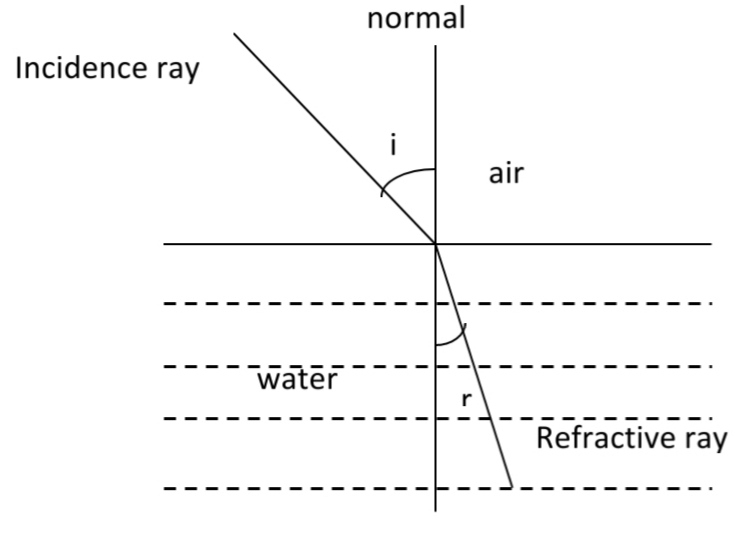
When a ray of light passes from air into a liquid , its direction is changed. This change of direction is called refraction.

Snell’s law describes the relation between the angles of incidence and refraction and may be written as:

n= sin i/ sin r

Where
i is the angle of incidence and
r the angle of refraction
According to the wave theory of light, the ratio of the sin of angles of incidence and refraction is identical to the ratio of the velocities of light in two media. Thus, 
n= sin i/ sin r = velocity in air/ velocity in liquid
When a ray of light passes from a rare to denser medium, the law of refraction is shown as 
sin i / sin r = n2/n1
Where 
n1 is the index of refraction of the rare medium
n2 the index of refraction of the denser medium.
The angle of incidence can never be greater then 90° and when it is 90° (sin90°=1), the above equation will be shown as:
sin r = n1/n2

MEASUREMENT

The refractive index of different substrates measure with refractometers. There are different types of refractometer.
  1. Abbe’s Refractometer
  2. Pulfrich Refractometer
  3. Immersion Refractometer
  4. V block Refractometer

  • Abbe’s Refractometer

Principle: The Abbe’s refractometer is used to measure the refractive index of a liquid. The working principle is based on the measurement of the critical angle. The light from a radiation source is reflected by a mirror and hits a double prism. A few drops of the sample are placed between this so-called Abbe double prism. The incident light beams pass through the double prism and sample only if their angles of incidence at the interface are less than the critical angle of total reflection. A microscope and a mirror with a suitable mechanism are used to determine the light / dark boundary line (shadow line).

Working: The sample is contained as a thin layer (~0.1mm) between two prisms. The upper prism is firmly mounted on a bearing that allows its rotation by means of the side arm. The lower prism is hinged to the upper to permit separation for cleaning and for introduction of the sample. A sodium lamp is projected through the illuminating prism, whose lower surface is ground or roughened, so that each point on this surface generates light rays in all directions, when light is reflected into the prism, this surface effectively becomes the source for an infinite number of rays that pass through the sample at all angels. 
The radiation is refracted at the interface of the sample and the smooth surface of the upper prism. After that, it passes into fixed telescope. The refractive index of a substance is a function of a wavelength. If the light source is not monochromatic, the light is scattered and the shadow boundary is not well defined. Instead of seeing a sharp edge between white and black, you will see a blue or red blurred border. In most cases, the measures are very inaccurate or even impossible. Therefore, to avoid dispersion,  Abbe added two compensating Amiciprisms. The position of the Amici prisms can be adjusted to correct dispersion. Two Amici prisms serve to collect the divergent critical angle rays of different colors into a single white beam. A telescope is rigidly fixed in the sector which is fixed to upright of base so that the axis coincides with the rotation of the prism lens. The eyepiece of the telescope is provided with crosshairs: in making a measurement, the prism angle is changed until the light-dark interface just coincides with the crosshairs. 
The position of the prism is then established from the fixed scale. Thermosetting is accomplished by circulation of water through the jackets surrounding the prism.

The Abbe's refractometer is very popular and owes its popularity to its convenience and to the minimal sample is needed.

  •  Pulfrich Refractometer

Principle: Pulfrich refractometer is the second design (after Abbé refractometer) that became commercially available in 19th century. It is another type of critical angle refractometer.
Working: A glass prism with a high refractive index comprises two planar polar faces which are perpendicular to one another and are placed such that one of them is vertical and the other is horizontal. The substance of which the refractive index is to be calculated is placed on the horizontal surface. A beam of monochromatic light is incident in a direction parallel to the horizontal surface so that the light entering the prism is at critical angle α. Finally, it emerges from the prism at an angle β.
The angle of refraction is measured with the help of telescope. The emergent beam forms a boundary of dark and bright side by the ray that grazes the prism surface, and the sharp boundary is observed with a telescope attached to a divided circle. If the refractive index of the glass nG is known and angle i (β) is measured, then n, the refractive index of the liquid sample can be calculated.
  n= √( n^2G – sin^2i)

FACTORS AFFECTING REFRACTIVE INDEX

Various factors that affect refractive index measurement are
1. Temperature: Temperature influences the refractive index of a medium primarily because of the accompanying change in density.
2. Wavelength of light used: The refractive index of a transparent medium gradually decreases with increasing wavelength; this effect is referred to as normal dispersion. 
3. Pressure: The refractive index of a substance increases with pressure because of the  accompanying rise in density. The effect is most pronounced in gases and it is yet smaller for solids.

APPLICATION OF REFRACTIVE INDEX

1. It is mainly used to identify a particular substance, confirm its purity or measure its concentration. Generally, it is used to measure the concentration of a solute in an aqueous solution. It can also be used in the determination of drug concentration in the pharmaceutical industry.
2. It is used to calculate the focal power of the lenses and the dispersive power of the prism.
3. It also applies to the estimation of the thermophysical properties of hydrocarbons and petroleum mixtures. 
4. It is used in the examination of organic compounds (oils, solvents, etc.), solutions, food products, serum protein concentration.
5. In medicine, a refractometer is used to measure total plasma protein in a blood sample and a specific gravity of urine.
6. It is used to determine the amount of sugar in sugar solutions and in general to determine total solids in fruits juices, tomato products, honey, syrups and soda water.

DIELECTRIC CONSTANT

Dielectric constant or relative permittivity (εr) of a solvent is measure of its polarity. The higher the dielectric constant of a solvent of a solvent, the more polar it is. It is a physical property.
Dielectric Constant (ε0) is the ratio between the permittivity of the medium (ε) to the permittivity of free space (ε0) Or is the ratio between force acting between two opposite charges at free space to force acting between two opposite charges at any medium. 
The characteristics of a dielectric material are determined by the dielectric constant.
K= F0 /F = (1/4Ï€r^2 × q1*q2/ε0) / (1/4Ï€r^2 × q1*q2/ε)
 = ε/ε0 = εr
The dielectric constant is effected both by the attractive forces that exist between the atoms and also the molecules. The solvent with a high dielectric constant makes it possible to more effectively screen the attractive and repulsive force between the ions. 

MEASUREMENT

It is measured by measuring the effect of the intervening solvent on the electric field between two opposite charged particles. first the capacitance of a test capacitor, C0, is measured with vacuum between its plates. Then, using the same capacitor and distance between its plates, the capacitance C with a dielectric between the plates is measured.  Then, the dielectric constant is obtained which is the ratio of the capacitance (C) of  a capacitor completely filled with the dielectric to the capacitance (Co) of the capacitor filled with space or vacuum. 
ε= C/C0   
and C0 = ε0 A/t 
Where
C= capacitance using the material as the dielectric in the capacitor, 
C0= capacitance using vacuum as the dielectric
ε0 = permittivity of free space (8.85 x 10⁻¹² F/m)
A = Area of the plate/ sample cross section area
t = Thickness of the sample

It has no dimension.

FACTORS AFFECTING DIELECTRIC CONSTANT

  • Frequency: The frequency of the applied voltage is one of the factors affecting dielectric constant. As the frequency of the applied voltage increases, the value of the dielectric constant becomes non-linear.
  • Applied voltage: When a direct current voltage is applied, the value of the dielectric constant reduces while applying alternating current voltage would increase the value of the dielectric constant.
  • Temperature: When the temperature is low, the alignment of the molecules in the dielectric material is difficult. By increasing the temperature, the dipoles in the dielectric material become dominant resulting in an increase in the dielectric constant. This temperature is known as the transition temperature. If the temperature rises above the transition temperature, then there will be a gradual decrease in the dielectric constant.

APPLICATION OF DIELECTRIC CONSTANT

A major use of dielectric is to manufacture capacitors. These have many uses, including strong energy in the electric field between the plates, filtering out noise from signals as part of resonant circuit and providing a burst of power to another component. 
Some application of dielectrics relay on their electrically insulting properties rather that their capacity to store charges. The most obvious of these uses is the insulation of the wires, cables etc.

DIPOLE MOMENT

When non-identical atoms (A and B ) are joined in a covalent bond, the pair of electrons will be attracted more strongly to the atoms that has the higher electronegativity. If A is more electronegative than B, it has a greater tendency to attract electrons. Thus, the shared pair of electron is drawn near A, leaving a positive charge on the B atom the molecule becomes dipolar (A-B+). It is the measurement of polarity.
A dipole moment is a quantity that describes two opposite charges separated by a distance.
The dipole moment, µ, is the product of the magnitude  of the separated charge and the distance of the separation.
µ =q x r
where 
q is the magnitude of the separated charge and 
r is the distance between them.
Greater the charge, larger will be dipole moment. And smaller the distance, larger will be dipole moment.
In SI units, q is expressed in coulombs and r in meters, so µ has the dimensions of C-m. It is expressed in the units of Debye and written as D ( 1 Debye = 1x10-18 e.s.u Cm). Dipole moment is vector quantity.

MEASUREMENT

When a solution of polar molecules is placed between two plates having opposite charge, they align themselves along the direction of the field. This process consumes energy that is returned to the electric circuit when the field is switched off, an effect known as electrical capacitance. The measurement of the capacitance of a gas or a solution serves to determine the magnitude of the dipole moment of a substance.

FACTORS AFFECTING DIPOLE MOMENT

  • Polarity of molecule: It is the measure of polarity. More stronger the polarity, more is the dipole moment.
  • Magnitude of charge: Larger the electronegativity, more is the dipole moment.
  • Geometry of molecule: In more complex molecules with polar covalent bonds, the three-dimensional geometry and the compound’s symmetry determine whether there is a net dipole moment. 
  • Mathematically, dipole moments are vectors; they possess both a magnitude and a direction. The dipole moment of a molecule is therefore the vector sum of the dipole moments of the individual bonds in the molecule. If the individual bond dipole moments cancel one another, there is no net dipole moment. Such is the case for CO2, a linear molecule. Each C–O bond in CO2 is polar, yet experiments show that the CO2 molecule has no dipole moment. Because the two C–O bond dipoles in CO2 are equal in magnitude and oriented at 180° to each other, they cancel. As a result, the CO2 molecule has no net dipole moment. In contrast, the H2O molecule is not linear, it is bent in three-dimensional space, so the dipole moments do not cancel each other. Thus a molecule such as H2O has a net dipole moment.

APPLICATION OF DIPOLE MOMENT

  • For predicting the nature of the molecules: The measurement of the dipole moment helps to distinguish polar and non-polar molecules. Molecules with a zero dipole moment are not polar while the molecule with a specific dipole moment is polar in nature.
  • Degree of polarity: The measurement of the dipole moment gives an idea of the degree of polarity in a diatomic molecule. The greater the dipole moment, the greater the polarity in such a molecule.
  • Shape of Molecules: The dipole moment is used to find the shape of molecules. If a molecule has a specific dipole moment, its shape will not be symmetrical, it may be curved or angular and the molecule at zero dipole will be symmetric and has a linear form.
  • Predict nature of bond: It is possible to predict the nature of chemical bond formed depending upon the electronegativities of atoms involved in a  molecule. The bond will be highly polar if the electronegativities of two atoms are large.

DISSOCIATION CONSTANT

Dissociation constant (Kd) is the tendency of a substance AxBy to reversibly dissociate (separate) in a solution into smaller compound A and B is shown as 
           AxBy = xA + yB
Dissociation constant (Kd) = [A]^x[B]^y/ [AxBy]
Where 
[A] is the molar concentration of A 
[B] is molar concentration of B and 
[AxBy] is the molar  concentration of AxBy.

Dissociation constant is defined as tendency of particular substance in solution is dissociated into ions. It is equal to the product of the respective ion concentrations divided by the concentration of the non-ions molecule. The acid dissociation constant (ka) is a quantitative measure of the strength of acid in the solution.
HA = A- + H+;
For this reaction Acid dissociation constant ka will be:
Ka = [A-][H+]/ [HA]

MEASUREMENT

pKa can be measured by using any one of the following methods:
Potentiometric titration, 
Spectrophotometric methods, 
NMR titration, 
Liquid chromatography (LC),
Capillary electrophoresis (CE) 
Combined methods, 
Computational methods

Of which potentiometer/half neutralisation is more common.
When a strong acid is titrated against strong base it forms a mixture of acid and its salt. The mixture acts as a buffer solution. During the course of titration acid concentration decreases and salt concentration goes on increasing. During any stage of titration the pH of buffer solution is explained by the Henderson –Hasselbalch equation.1
pH = pKa + log [Salt]/ [Acid] …… (1)
Where, 
pKa = -logKa and Ka = dissociation constant of the acid
[Salt] = concentration of salt 
[Acid] = concentration of acid 
At the half neutralization point 
[Salt] = [Acid]
And equation (1) above gives pH = pKa

FACTORS AFFECTING DISSOCIATION CONSTANT 

Nature of electrolyte: Stronger the electrolyte, more is the dissociation and vice versa.
Nature of solvent: More is the dielectric constant of the solvent, more is the dissociation.
Concentration: Lesser the concentration, greater is the ionisation.
Temperature: Higher the temperature, more is the ionisation.

APPLICATION OF DISSOCIATION CONSTANT

The acid-base dissociation constant (pKa) of a drug is a key physic-chemical parameter influencing many biopharmaceutical  characteristics.
The knowledge of the pKa values is important for for the quantitative evaluation of systems involving acid-base equilibria in solution.
Dissociation constant (Ka) is also essential for working with buffers. The design of these solutions depends on a knowledge of the pKa value  of their components.
Other application of Ka is with pH indicators. A pH indicator is a weak acid or a weak base which changes color in the transition pH range , is about pKa  1.

OPTICAL ROTATION

Many substances process the inherent property to rotate the plane of incident polarized light. This is called optical activity.Optical rotation is the angle at which the plane of polarization is rotated when the polarized light passes through a layer of one liquid.
The optically active substances are described as dextrorotatory or levorotatory depending  on whether the plane of polarization is rotated clockwise or anticlockwise.
Dextro rotator or right handed: The substance which rotates plane of polarization of light towards right or in clockwise direction are called dextrorotatory or right handed. The dextrorotation is designated(+)
Laevo rotator or left handed: The substance which rotates plane of polarization of light towards left or in anti-clockwise directions are called laevo rotator or left handed. Levorotation is designated(-)
In the International Pharmacopoeia, optical rotation (α) is expressed in angular degrees. In the SI, the optical rotation angle is expressed in radians (rad).
Where [α]  = optical rotation (Unit – degrees cm3/dm g)
λ = wavelength in nanometer
α = measured angle of rotation 
T = temperature in degrees
l = path length in dm
c = concentration of sample in g/ml

MEASUREMENT

Polarimeters measure the degree of rotation of polarized light as it passes through an optically active material.
INSTRUMENTATION
A polarimeter consists of a:
  • Polarized light source 
  • ( sodium vapour lamp),
  • Polarizer
  • Analyzer and 
  • Sample tube
  • Detector
PROCEDURE
When light is passed through a polarizer only light oscillating in one plane will leave the polarizer. The plane-polarized light is introduced to a tube containing a solution with the substance to be measured.  If the substance is optical inactive, the plane of the polarized light will not change in orientation and the observer will read an angle of [α]=00. If the compound in the  polarimetry cell was optical active, the plane of the light would be rotated on its way throught the tube either clockwise or counter clockwise direction depending on the nature of the compound.
For clockwise direction the rotation (in degrees) is defined as positive (“+”) and called dextrorotatory. In contrast, the counter clockwise is defined as negative (“ – “ ) and called levorotatory.

FACTORS AFFECTING OPTICAL ROTATION  

  • For a given compound, the extent and direction of this rotation depends on the orientation of the molecules in relation to the beam.
  • Direction of beam onto the molecule.
  • Physical properties of crystal it is directly proportional.
  • Thickness of crystal.
  • Mass density of the crystal or concentration in the case of solutions. 
  • Wavelength of light used
  • The temperature of the solution.

APPLICATION OF OPTICAL ROTATION 

  1. Identification and determination of optically active compounds
  2. Sugar industry: Polarimeters are used in the sugar industry to determine the quality of juice from sugarcane and refined sucrose. Often, sugar refineries use a modified polarimeter with a flow cell called a saccharimeter.
  3. Chemical industry:  Many chemical exhibit specific rotation as a unique property that can be used to distinguish it.
  4. Food, beverage and pharmaceutical industries: The concentration and purity measurements of the samples which have specific rotations can be calculated with a polarimeter . These include: Steroids, Diuretics, Antibiotics, Narcotics, Vitamins, Analgesics.
  5. If the specific rotation of a sample is known its concentration in the solution can be estimated.
  6. If the concentration of the material in the sample is known then its specific rotation can be determined.

MECHANISM OF CELLULAR DRUG ABSORPTION

MECHANISM OF DRUG ABSORPTION Link for video demonstration of this topic 👇  https://youtu.be/v-nVH7y1Cc8 The three broad categories of drug ...